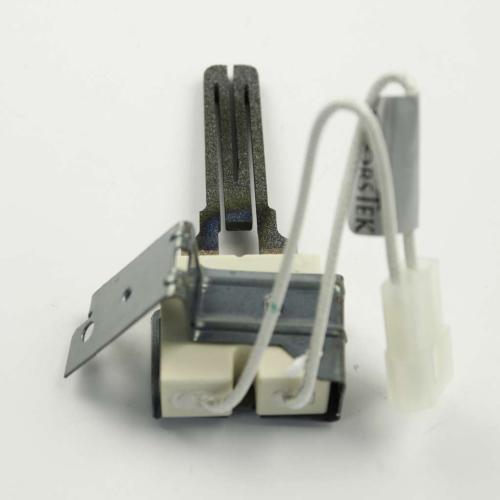
GE Dryer Heating Element, Burner, Coil & Igniter Parts

GE Dryer Heating Element, Burner, Coil & Igniter Parts Parts

A GE dryer that tumbles without heat can have a lost supply leg, open thermostat, failed control, restricted airflow, open electric heater, or incomplete gas ignition sequence. Confirm the energy source and safety circuit before selecting the GE dryer heater assembly WE11X27519 or a gas ignition part. Gas and electric heat parts are not interchangeable, and the same no-heat symptom can originate outside this collection.

On an electric dryer, both supply legs must be present even when the motor runs. With power isolated, inspect the heater coil for breaks, sagging sections, and contact with the metal housing. Test each terminal-to-terminal path and each terminal to the housing. Continuity from a heater terminal to the case indicates an unintended ground path. The GE dryer mica heater and housing assembly WE11X20397 must remain electrically isolated from its metal enclosure.

On a gas dryer, observe the ignition sequence only through the designated viewing area with panels installed. The igniter normally glows before the valve opens and the flame lights. No glow, glow without flame, or a flame that lights once and fails on later cycles lead to different tests involving the igniter, flame sensor, valve coils, gas supply, thermostats, and airflow. Never attempt to light a dryer burner by hand.

Quick inspection sequence

  • Identify whether the dryer is electric or gas and record whether it tumbles, heats briefly, overheats, trips protection, or never heats.
  • For an electric dryer, verify the complete supply at the approved test point. One missing line can allow tumbling without heater operation.
  • Disconnect power and inspect heater terminals, ceramic supports, coil spacing, housing, wiring, and ground clearance for burns or melted insulation.
  • For a gas dryer, shut off gas before disassembly. Inspect the igniter for cracks and the burner area for lint, corrosion, damaged wiring, or displaced shields.
  • Check the lint filter, blower path, exhaust duct, and outside damper. Restricted airflow can open thermal protection and shorten heater life.
  • Test thermostats, sensors, fuses, relays, and harness connections according to the wiring diagram before replacing a heat-producing assembly.

Match the correct GE dryer heating elements, burners, coils, and igniter part

  • Match the full part number and fuel type first. Electric heater assemblies and gas ignition parts belong to different circuits and mounting systems.
  • For an electric heater, compare wattage, voltage, terminal placement, coil layout, housing diameter, mounting holes, shields, and included insulators.
  • For an igniter or burner component, compare connector, mounting bracket, element shape, ceramic length, burner position, and assigned valve system.
  • Determine whether the listing is a complete housing assembly, bare coil kit, igniter only, burner assembly, or repair kit. Do not transfer scorched terminals into a new heater.

Common problems and repair checks

Why does the GE electric dryer tumble but produce no heat?

Check both supply legs, then test the thermal protection, control output, wiring, and heater with power disconnected. A visibly broken coil or an open terminal-to-terminal reading supports heater replacement, but an open fuse or burned connector must be traced to its cause. The GE dryer heating element and housing assembly WE11X21156 is a complete assembly for specified configurations. Match the terminals, housing, and mounting points, and correct restricted airflow before installation so the replacement is not exposed to the same overheating condition.

Why does the GE dryer get too hot even on a lower setting?

Stop using the dryer if the cabinet becomes abnormally hot or the heater remains energized during cooldown. Inspect the vent, blower path, cycling controls, relay, and heater for a coil touching its metal housing. Test from each heater terminal to the case with all wires removed and power isolated. If a grounded or distorted element is confirmed, replace the matched assembly, such as the GE dryer heater assembly WE11X33137. A new heater alone will not fix a welded relay, blocked exhaust, or missing temperature feedback.

Why does the GE gas dryer igniter glow but the burner does not light?

Shut off the dryer if gas odor is present. A glowing igniter shows that part of the circuit is operating, but the igniter may still draw insufficient current, the flame sensor may not switch, the valve coils may not open, or gas may be unavailable. Test the complete ignition sequence using approved procedures. If the igniter is cracked or fails its specified electrical test, replace it with the GE dryer gas igniter WE04X25996. Handle the element by its ceramic base and never touch or flex the fragile heating surface.

Why does the GE dryer heat for a few minutes and then turn cold?

Check whether heat returns after a long cooldown. Restricted airflow can open a high-limit device, while weak gas valve coils can fail after warming. On electric designs, a cracked coil or loose terminal may open as the assembly expands. Inspect the filter, duct, blower, connectors, and temperature controls before choosing a heat part. If the electric heater assembly opens when warm and matches the original housing, the GE dryer heating element and housing assembly WE11M23 may be the correct repair. Do not bypass a thermostat to keep the heater operating.

Why does a replacement GE dryer heating element fail again?

Repeat failure points to airflow restriction, a grounded coil, incorrect wiring, loose high-current terminals, missing insulators, a control that does not cycle heat, or the wrong replacement. Inspect the full exhaust path and repair any heat-darkened connector before fitting another element. When the assigned design uses the GE dryer heating element and housing assembly WE11M27, preserve every shield and ceramic support and verify the coil cannot touch the case. Run the dryer through heat and cooldown while confirming the outside damper opens freely.

Why does the GE dryer trip the breaker when heat starts?

Leave the dryer disconnected until the heater, wiring, terminal block, and branch circuit are inspected. A coil touching the housing, melted terminal, pinched wire, incorrect connection, or weak breaker can trip when the heat load energizes. Isolate the heater and test each terminal to the metal case. For systems using a separate replacement coil, the GE dryer heating element coil kit WE11X203 must be installed with the exact insulators, spacing, and tension specified for its housing. A coil kit must never contact metal along its full heated length.

Symptom and decision guide

Observed symptom

Check before ordering

Repair direction

Tumbles with no electric heat

Two supply legs, fuses, thermostats, relay, heater continuity

Isolate the open point before ordering

Igniter glows without flame

Igniter current, sensor, valve coils, gas supply

Service the confirmed ignition component

Heat stops after warm-up

Airflow, high-limit cycling, warm coil or valve failure

Test under the failure condition safely

Breaker trips when heat starts

Heater-to-case fault, wiring, terminal block, circuit

Keep disconnected until the fault is corrected

Related GE dryer part categories

If heat shuts down because temperature protection is opening, inspect the GE dryer thermostat and sensor collection. Replace a safety device only after correcting the overheating source.

When the burner or heater is sound but heat commands are missing, review the GE dryer control board collection. Confirm relay output and harness condition before replacing electronics.

For long dry times with normal heat production, compare the GE dryer grille, vent, hose, and tube collection. Exhaust restriction can mimic weak heat and damage new components.

Installation and safety

  1. Disconnect electrical power. Shut off the gas supply for any gas-dryer repair and allow heat-producing components to cool completely.
  2. Photograph terminals, shields, thermostats, insulators, brackets, and duct joints. Support the heater housing so wiring is not carrying its weight.
  3. Install the exact assembly without stretching coils or touching an igniter element. Replace damaged terminals and restore all grounds, shields, and thermal devices.
  4. Inspect the full airflow path, then perform the approved electrical or gas leak checks. Test ignition or heating, cycling, exhaust flow, and cooldown.

Before-ordering checklist

Verify

What must match

Heat system

Electric heater, heater and housing, coil kit, gas igniter, burner, or valve-related component

Electrical match

Part number, voltage, wattage, terminals, connector, coil path, insulation, and grounding clearance

Mechanical match

Housing, bracket, shields, mounting holes, burner position, ceramic supports, and duct seals

Root-cause check

Supply, controls, thermostats, airflow, high-current terminals, gas supply, and complete cooldown

Search result

Show filters
1 - 40 out of 12 results found in 0.003s
Sorted by

A GE dryer that tumbles without heat can have a lost supply leg, open thermostat, failed control, restricted airflow, open electric heater, or incomplete gas ignition sequence. Confirm the energy source and safety circuit before selecting the GE dryer heater assembly WE11X27519 or a gas ignition part. Gas and electric heat parts are not interchangeable, and the same no-heat symptom can originate outside this collection.

On an electric dryer, both supply legs must be present even when the motor runs. With power isolated, inspect the heater coil for breaks, sagging sections, and contact with the metal housing. Test each terminal-to-terminal path and each terminal to the housing. Continuity from a heater terminal to the case indicates an unintended ground path. The GE dryer mica heater and housing assembly WE11X20397 must remain electrically isolated from its metal enclosure.

On a gas dryer, observe the ignition sequence only through the designated viewing area with panels installed. The igniter normally glows before the valve opens and the flame lights. No glow, glow without flame, or a flame that lights once and fails on later cycles lead to different tests involving the igniter, flame sensor, valve coils, gas supply, thermostats, and airflow. Never attempt to light a dryer burner by hand.

Quick inspection sequence

  • Identify whether the dryer is electric or gas and record whether it tumbles, heats briefly, overheats, trips protection, or never heats.
  • For an electric dryer, verify the complete supply at the approved test point. One missing line can allow tumbling without heater operation.
  • Disconnect power and inspect heater terminals, ceramic supports, coil spacing, housing, wiring, and ground clearance for burns or melted insulation.
  • For a gas dryer, shut off gas before disassembly. Inspect the igniter for cracks and the burner area for lint, corrosion, damaged wiring, or displaced shields.
  • Check the lint filter, blower path, exhaust duct, and outside damper. Restricted airflow can open thermal protection and shorten heater life.
  • Test thermostats, sensors, fuses, relays, and harness connections according to the wiring diagram before replacing a heat-producing assembly.

Match the correct GE dryer heating elements, burners, coils, and igniter part

  • Match the full part number and fuel type first. Electric heater assemblies and gas ignition parts belong to different circuits and mounting systems.
  • For an electric heater, compare wattage, voltage, terminal placement, coil layout, housing diameter, mounting holes, shields, and included insulators.
  • For an igniter or burner component, compare connector, mounting bracket, element shape, ceramic length, burner position, and assigned valve system.
  • Determine whether the listing is a complete housing assembly, bare coil kit, igniter only, burner assembly, or repair kit. Do not transfer scorched terminals into a new heater.

Common problems and repair checks

Why does the GE electric dryer tumble but produce no heat?

Check both supply legs, then test the thermal protection, control output, wiring, and heater with power disconnected. A visibly broken coil or an open terminal-to-terminal reading supports heater replacement, but an open fuse or burned connector must be traced to its cause. The GE dryer heating element and housing assembly WE11X21156 is a complete assembly for specified configurations. Match the terminals, housing, and mounting points, and correct restricted airflow before installation so the replacement is not exposed to the same overheating condition.

Why does the GE dryer get too hot even on a lower setting?

Stop using the dryer if the cabinet becomes abnormally hot or the heater remains energized during cooldown. Inspect the vent, blower path, cycling controls, relay, and heater for a coil touching its metal housing. Test from each heater terminal to the case with all wires removed and power isolated. If a grounded or distorted element is confirmed, replace the matched assembly, such as the GE dryer heater assembly WE11X33137. A new heater alone will not fix a welded relay, blocked exhaust, or missing temperature feedback.

Why does the GE gas dryer igniter glow but the burner does not light?

Shut off the dryer if gas odor is present. A glowing igniter shows that part of the circuit is operating, but the igniter may still draw insufficient current, the flame sensor may not switch, the valve coils may not open, or gas may be unavailable. Test the complete ignition sequence using approved procedures. If the igniter is cracked or fails its specified electrical test, replace it with the GE dryer gas igniter WE04X25996. Handle the element by its ceramic base and never touch or flex the fragile heating surface.

Why does the GE dryer heat for a few minutes and then turn cold?

Check whether heat returns after a long cooldown. Restricted airflow can open a high-limit device, while weak gas valve coils can fail after warming. On electric designs, a cracked coil or loose terminal may open as the assembly expands. Inspect the filter, duct, blower, connectors, and temperature controls before choosing a heat part. If the electric heater assembly opens when warm and matches the original housing, the GE dryer heating element and housing assembly WE11M23 may be the correct repair. Do not bypass a thermostat to keep the heater operating.

Why does a replacement GE dryer heating element fail again?

Repeat failure points to airflow restriction, a grounded coil, incorrect wiring, loose high-current terminals, missing insulators, a control that does not cycle heat, or the wrong replacement. Inspect the full exhaust path and repair any heat-darkened connector before fitting another element. When the assigned design uses the GE dryer heating element and housing assembly WE11M27, preserve every shield and ceramic support and verify the coil cannot touch the case. Run the dryer through heat and cooldown while confirming the outside damper opens freely.

Why does the GE dryer trip the breaker when heat starts?

Leave the dryer disconnected until the heater, wiring, terminal block, and branch circuit are inspected. A coil touching the housing, melted terminal, pinched wire, incorrect connection, or weak breaker can trip when the heat load energizes. Isolate the heater and test each terminal to the metal case. For systems using a separate replacement coil, the GE dryer heating element coil kit WE11X203 must be installed with the exact insulators, spacing, and tension specified for its housing. A coil kit must never contact metal along its full heated length.

Symptom and decision guide

Observed symptom

Check before ordering

Repair direction

Tumbles with no electric heat

Two supply legs, fuses, thermostats, relay, heater continuity

Isolate the open point before ordering

Igniter glows without flame

Igniter current, sensor, valve coils, gas supply

Service the confirmed ignition component

Heat stops after warm-up

Airflow, high-limit cycling, warm coil or valve failure

Test under the failure condition safely

Breaker trips when heat starts

Heater-to-case fault, wiring, terminal block, circuit

Keep disconnected until the fault is corrected

Related GE dryer part categories

If heat shuts down because temperature protection is opening, inspect the GE dryer thermostat and sensor collection. Replace a safety device only after correcting the overheating source.

When the burner or heater is sound but heat commands are missing, review the GE dryer control board collection. Confirm relay output and harness condition before replacing electronics.

For long dry times with normal heat production, compare the GE dryer grille, vent, hose, and tube collection. Exhaust restriction can mimic weak heat and damage new components.

Installation and safety

  1. Disconnect electrical power. Shut off the gas supply for any gas-dryer repair and allow heat-producing components to cool completely.
  2. Photograph terminals, shields, thermostats, insulators, brackets, and duct joints. Support the heater housing so wiring is not carrying its weight.
  3. Install the exact assembly without stretching coils or touching an igniter element. Replace damaged terminals and restore all grounds, shields, and thermal devices.
  4. Inspect the full airflow path, then perform the approved electrical or gas leak checks. Test ignition or heating, cycling, exhaust flow, and cooldown.

Before-ordering checklist

Verify

What must match

Heat system

Electric heater, heater and housing, coil kit, gas igniter, burner, or valve-related component

Electrical match

Part number, voltage, wattage, terminals, connector, coil path, insulation, and grounding clearance

Mechanical match

Housing, bracket, shields, mounting holes, burner position, ceramic supports, and duct seals

Root-cause check

Supply, controls, thermostats, airflow, high-current terminals, gas supply, and complete cooldown

30 products

Part

GE Dryer Heating Element Assembly - WE11X21156
WE11X21156
$155.95 $202.74

In stock 220 Products

Quick View

In stock 220 Products

Part

GE

$155.95 $202.74
Quick View

Part

GE Dryer Heating Element - WE11M10001
WE11M10001
$145.95 $189.74

In stock 11 Products

Quick View

In stock 11 Products

Part

GE

$145.95 $189.74
Quick View

Part

GE Washers & Dryers Heater and Housing Assembly – WE11M23
WE11M23
$129.95 $136.95

In stock 6 Products

Quick View

In stock 6 Products

Part

GE

$129.95 $136.95
Quick View

Part

GE Dryer Igniter WE04X25996
WE04X25996
$43.97 $57.17

In stock 133 Products

Quick View

In stock 133 Products

Part

GE

$43.97 $57.17
Quick View

Part

Ge Thermal Limiter - WE04X10094
WE04X10094
$52.89 $68.76

In stock 1 Products

Quick View

In stock 1 Products

Part

GE

$52.89 $68.76
Quick View

Part

Ge Heater And Housing Asm - WE11M61
WE11M61
$218.95 $284.64

In stock 3 Products

Quick View

In stock 3 Products

Part

GE

$218.95 $284.64
Quick View

Part

GE Heater Assembly WE11X27519
WE11X27519
$95.64 $124.33

In stock 3 Products

Quick View

In stock 3 Products

Part

GE

$95.64 $124.33
Quick View

Part

GE Dryer Burner Igniter - WE4M449
WE4M449
$88.82 $95.82

In stock 16 Products

Quick View

In stock 16 Products

Part

GE

$88.82 $95.82
Quick View

Part

GE Washers and Dryer Main Coil WE4X693
WE4X693
$37.95 $49.34

In stock 0 Products

Quick View

In stock 0 Products

Part

GE

$37.95 $49.34
Quick View

Part

GE Washers and Dryer Mica Heater and Housing Assembly WE11X20397
WE11X20397
$145.95 $189.74

In stock 12 Products

Quick View

In stock 12 Products

Part

GE

$145.95 $189.74
Quick View

Part

Ge Burner Asm - WE14X10110
WE14X10110
$27.85 $36.21

In stock 0 Products

Quick View

In stock 0 Products

Part

GE

$27.85 $36.21
Quick View

Part

Ge Htr&Hsg Asm - WE11X99
WE11X99
$188.85 $245.51

In stock 1 Products

Quick View

In stock 1 Products

Part

GE

$188.85 $245.51
Quick View

Part

Ge Htr Asm 240V - WE11X103
WE11X103
$162.95 $211.84

In stock 1 Products

Quick View

In stock 1 Products

Part

GE

$162.95 $211.84
Quick View

Part

Ge Heater Asm. Coin - WE11M27
WE11M27
$180.85 $235.11

In stock 0 Products

Quick View

In stock 0 Products

Part

GE

$180.85 $235.11
Quick View

Part

Ge Ignitor - WE04X10116
WE04X10116
$160.85 $209.11

In stock 1 Products

Quick View

In stock 1 Products

Part

GE

$160.85 $209.11
Quick View

Part

Ge Heater Assembly - WE11X26400
WE11X26400
$112.34 $119.34

In stock 3 Products

Quick View

In stock 3 Products

Part

GE

$112.34 $119.34
Quick View

Part

Ge Htr Coil Kit - WE11X203
WE11X203
$48.45 $55.45

In stock 43 Products

Quick View

In stock 43 Products

Part

GE

$48.45 $55.45
Quick View

Part

Ge Heater Coil 240V - WE11X10007
WE11X10007
$71.04 $92.36

In stock 0 Products

Quick View

In stock 0 Products

NLA

GE

$71.04 $92.36
Quick View

Part

WE14X25075
$144.95 $188.44

In stock 0 Products

Quick View

In stock 0 Products

Part

GE

$144.95 $188.44
Quick View

Part

WE11X33137
$87.95 $94.95

In stock 0 Products

Quick View

In stock 0 Products

Part

GE

$87.95 $94.95
Quick View

Frequently Asked Questions

Quick answers for your replacement part needs

Where can I find genuine replacement parts for my appliance?

Finding genuine replacement parts for your appliances has never been easier! We offer authentic parts for over 250 brands, including LG, Samsung, Whirlpool, Kenmore, Bosch, and Liebherr. Simply enter your appliance's model number on our website, and explore our extensive selection of compatible parts designed to restore your appliance's peak performance and reliability.

What type of appliance parts and accessories are available for purchase?

Are your replacement parts compatible with all models?

What if I can’t find the appliance part I need?

How can I track my order for appliance parts online?

How long will it take to receive my replacement parts order?

Can I return appliance parts if they are not compatible with my model?

How can I update my shipping address after placing an order?

How can I get in touch with customer support?

Couldn’t find the answer to your question?

Your satisfaction matters. Let us know how we can assist with your repair journey.

Your Cart ( 0 items)

You currently have 0 items in your Cart

Return to shop
Menu

Compatible Models